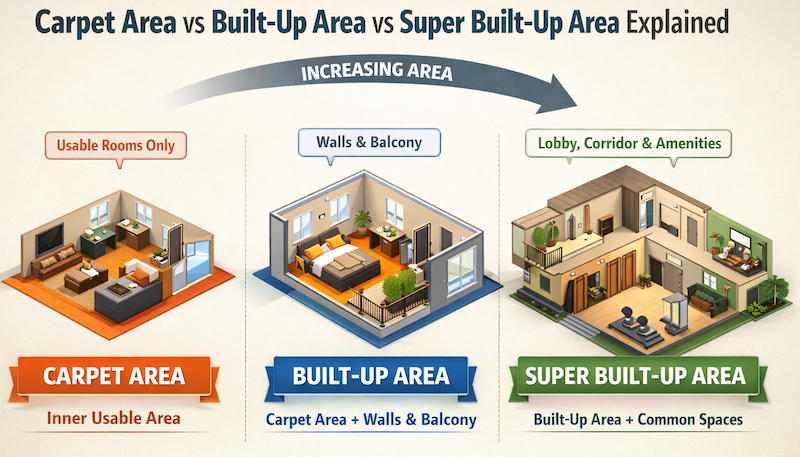
Carpet Area vs Built-Up Area vs Super Built-Up Area Explained
Introduction: Why Area Definitions Matter When Buying Property
When buying property, buyers often see different terms like carpet area, built-up area, and super built-up area on sales brochures and property listings. These terms can be confusing, especially for first-time buyers who might assume all three measurements refer to the same thing. In Mumbai’s high-stakes real estate market, where every square foot carries a significant cost, misunderstanding these definitions can lead to wrong expectations and even disputes at the time of possession.
Understanding these measurements helps buyers evaluate the actual usable space and the true value of a property. We have seen many buyers get surprised when they move into their new home and find the actual living space feels smaller than what they expected based on the advertised area. The difference between these three terms can be significant – sometimes hundreds of square feet – which directly affects how much living space you get for your money.
This article clarifies the differences between carpet area, built-up area, and super built-up area so you can make better property decisions, compare projects fairly, and focus on what matters most: the space you will actually use every day.
What is Carpet Area?
Carpet area refers to the actual usable floor area inside a flat. Think of it as the space where you can literally lay a carpet – hence the name. This is the area inside the walls of the apartment where you will actually live and place your furniture. It is the most important number for judging whether a 2BHK or 3BHK will suit your family’s needs.
What Carpet Area Includes
The carpet area includes:
- Bedrooms – The full floor area within the bedroom walls where you place beds and wardrobes.
- Living room – The space for seating, entertainment, and daily use.
- Kitchen – The internal kitchen floor area, excluding any service balcony.
- Bathrooms – The area inside each bathroom.
- Internal passage areas – Corridors and lobbies inside the flat that you use to move between rooms.
What Carpet Area Excludes
The carpet area excludes:
- Balcony – Even if it is attached to your flat, it is not part of carpet area unless the developer explicitly includes it under local norms.
- External walls – The thickness of outer and party walls is not counted.
- Common areas – Lifts, building corridors, staircases, and lobby areas are never part of your flat’s carpet area.
RERA and Carpet Area
RERA (Real Estate Regulatory Authority) defines carpet area clearly to ensure transparency for buyers. This was a game-changer because earlier, developers could use confusing measurements that made it hard for buyers to understand what they were actually getting. Under RERA, the carpet area must be clearly stated in the agreement and in marketing material, so you can verify it on the RERA portal and hold the developer accountable if the delivered area is less than promised.
From our experience talking to property buyers, carpet area is what matters most for daily living. When you are deciding if a 2BHK has enough space for your family, you are really thinking about the carpet area.
What is Built-Up Area?
Built-up area includes carpet area plus the thickness of internal and external walls. It may also include balcony or terrace areas depending on the specific project and developer policies. In other words, it is the total area that your unit “occupies” in the building, including the space taken by walls.
Built-up area is usually 10–20% larger than carpet area. The exact difference depends on the construction style and wall thickness used in the building. High-rise buildings with thicker structural walls and duct spaces will show a larger gap between carpet and built-up area than low-rise or thin-wall constructions.
A Simple Example
If your carpet area is 800 square feet, your built-up area might be around 920–960 square feet. The additional 120–160 square feet comes from wall thickness and potentially balcony space. You do not get extra “room” to use – the walls do not give you more living space – but they do take up physical area in the building structure, and developers often quote both numbers.
Many buyers get confused between carpet area and built-up area. It helps to remember: carpet = what you use; built-up = carpet + walls (and sometimes balcony).
What is Super Built-Up Area?
Super built-up area includes built-up area plus a proportionate share of common areas in the building. This is where pricing often gets tricky, because you end up paying for space you do not exclusively use.
Common Areas Included in Super Built-Up Area
Common areas that get included in super built-up area calculations typically include:
- Lobbies and building entrance
- Staircases and lifts
- Corridors on each floor
- Clubhouse areas
- Swimming pool and deck
- Gym and recreation spaces
- Garden and landscaping areas
- Some projects also allocate a share of parking or storage to super built-up calculations, depending on the developer’s policy.
Developers often use super built-up area for pricing their units. This means you are paying for amenities and common spaces even though you cannot use them exclusively. Super built-up area is sometimes referred to as the saleable area. From a developer’s perspective, this makes sense because they need to recover costs for all the common facilities they build; from a buyer’s perspective, it can make two projects with similar “saleable area” feel very different in terms of actual living space.
Difference Between Carpet Area, Built-Up Area, and Super Built-Up Area
A clear way to remember the three is:
- Carpet area → Actual usable space inside the apartment where you live daily. This is the number that should drive your decision on whether the flat is big enough for you.
- Built-up area → Carpet area + wall thickness + balconies (if included by the developer). It reflects the “footprint” of your unit in the building.
- Super built-up area → Built-up area + proportionate share of common spaces (lobbies, lifts, corridors, amenities). This is often the number used for price per sq ft in brochures.
The progression makes sense when you think about it step by step: you start with your living space, add the structural elements, then add a share of shared facilities. Buyers should focus on carpet area when evaluating usable living space, but understanding all three helps you make sense of pricing and compare different properties fairly.
We always tell buyers to ask developers to clearly break down how they calculate each measurement. Some developers are more generous with balcony inclusion or common area calculations than others, so the same “super built-up” number can mean different carpet areas in different projects.
Why Carpet Area Matters Most for Buyers
Carpet area is important because it represents the actual space you can use for living. When you are planning furniture layout or thinking about whether you have enough room for your family, carpet area is what counts.
Fair Price Comparisons
Pricing comparisons become easier when you focus on carpet area. Two properties might have similar super built-up areas but very different carpet areas. The one with more carpet area gives you better value for daily living. Always ask for “price per sq ft on carpet area” when comparing – that reflects the real cost of usable space.
Real Value of the Property
Carpet area helps buyers understand the real value of the property. You are essentially paying for living space, and carpet area measures exactly that. Under RERA regulations, developers must disclose carpet area clearly in all their marketing materials and agreements. This transparency protects buyers from misleading advertisements.
In our experience, too many buyers get caught up in impressive super built-up area numbers without checking the actual living space they are getting. A 1,200 sq ft super built-up flat with only 750 sq ft carpet area is very different from one with 900 sq ft carpet – and the latter usually offers better value for a family.
Example Calculation: How the Numbers Stack Up
Here is a practical example that shows how these numbers work together:
| Component | Area (sq ft) |
|---|---|
| Carpet area | 800 |
| Wall thickness and balconies | 120 |
| Built-up area | 920 |
| Share of common areas | 180 |
| Super built-up area | 1,100 |
Notice how the super built-up area is 37% larger than the carpet area in this example. If the developer quotes prices based on super built-up area (e.g. Rs 25,000 per sq ft), the effective price per sq ft of carpet area is much higher: (1,100 × 25,000) ÷ 800 = Rs 34,375 per sq ft of carpet. This example shows why comparing properties requires looking at the same measurement type. A 1,100 sq ft super built-up apartment might have less living space than a 950 sq ft built-up apartment in a different project, depending on how each developer defines and allocates areas.
Things Buyers Should Check Before Buying a Property
Here is practical advice based on common buyer mistakes we have observed:
Verify the Carpet Area in the Agreement
Make sure the carpet area mentioned in the sale agreement matches what the sales team promised you. Discrepancies between marketing materials and legal documents are a common source of post-possession disputes. Get it in writing and cross-check with the RERA-registered carpet area for the unit.
Check RERA Registration and Carpet Area
Check RERA registration details for the project. The RERA website shows official carpet area measurements that developers have committed to delivering. If the delivered carpet area is less than the RERA-disclosed area, you may be entitled to compensation or price adjustment as per RERA norms.
Understand How the Developer Calculates Super Built-Up Area
Some developers include parking, storage, or niche areas in super built-up; others do not. Ask for a clear breakdown: carpet area, built-up area, and how common area is proportionately charged. This helps you compare projects fairly and avoid surprises.
Compare Prices on Carpet Area
Always compare prices based on carpet area when evaluating multiple options. This gives you the most accurate comparison between different properties and developers. A project that looks cheaper on super built-up rate may actually be costlier per sq ft of usable space.
Site Visit and Measurement
Where possible, visit the site and see the actual flat or a similar unit. If you can, measure key rooms to get a sense of whether the quoted carpet area feels right. Sometimes the actual delivered area differs slightly from promised measurements; good developers offer compensation or price adjustments for shortfalls as per RERA.
Always read the fine print about what happens if the delivered carpet area is less than promised. RERA provides for interest or compensation in such cases – ensure your agreement reflects that.
Conclusion
Understanding the difference between carpet area, built-up area, and super built-up area helps buyers make informed property decisions. These measurements serve different purposes, but carpet area gives you the clearest picture of actual living space.
Buyers should focus on carpet area when comparing properties and always review project details carefully before purchasing. Do not get swayed by impressive super built-up area numbers without understanding what carpet area you are actually getting for your money. The transparency brought by RERA regulations has made it easier for buyers to make informed choices – take advantage of this by always asking for clear area breakdowns and comparing properties on the same measurement basis.
Ready to Explore Mumbai's Premium Real Estate?
Our expert team is here to help you navigate the luxury property market. Whether you're looking to invest in prime locations or find your dream home, we provide personalized guidance every step of the way.
Schedule a Consultation | View Premium Properties
DHM Estates - 3 Decades of Trust in Mumbai Real Estate
Frequently Asked Questions
What is the difference between carpet area and built-up area?
Carpet area is the actual usable floor area inside the flat (where you can place furniture). Built-up area is carpet area plus the thickness of internal and external walls, and often includes balcony. Built-up is typically 10–20% more than carpet area.
Why do developers quote super built-up area for pricing?
Developers use super built-up area (saleable area) to recover the cost of common amenities like lobbies, lifts, corridors, clubhouse, and gardens. You pay a proportionate share even though you do not exclusively use those spaces. Always ask for carpet area and price per sq ft on carpet to compare fairly.
Does RERA define carpet area?
Yes. RERA defines carpet area and mandates that developers disclose it clearly in agreements and marketing. The RERA portal shows the registered carpet area for each unit, which protects buyers if the delivered area is less than promised.
How do I compare two properties with different area types?
Convert everything to a common basis – ideally carpet area. Ask both developers for carpet area and total price, then compute price per sq ft of carpet area. That comparison tells you which property gives more usable space for your budget.
Can the delivered carpet area be less than what was promised?
If the project is RERA-registered, the agreement and RERA registration specify the carpet area. If the delivered area is less, you may be entitled to compensation or price adjustment as per RERA norms. Always verify the carpet area in the agreement and on the RERA website.
Disclaimer: This article is for informational purposes only and should not be considered legal or professional advice. Please consult with legal and real estate professionals for specific guidance on property transactions and area definitions.
Explore homes that match this insight
If this article resonates with your plans, our team can help you translate it into a precise property short-list across Worli, BKC, South Mumbai or other micro-markets.